
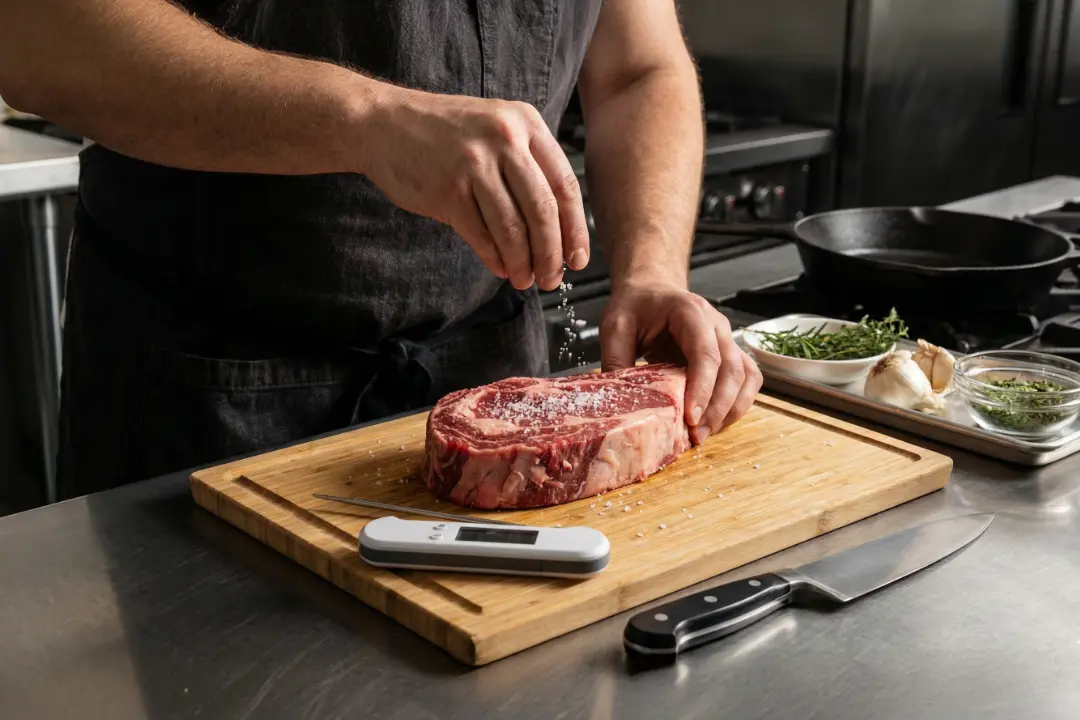
In the 2026 culinary landscape, the boundary between the professional “back-of-house” and the ambitious home kitchen has vanished. We have entered the era of “Analog Rituals,” where high-precision meat preparation replaces fast-casual convenience.
To master meat is to master the intersection of physics and chemistry. This guide details the “Pro-Prep” workflow used in Michelin-starred environments—from thermal stabilization to the precision science of the “Blade Finish.”
1. Pre-Preparation: Ending the “Fridge Shock” Cycle
Most home cooks commit a critical error: moving a protein directly from a 4°C (39°F) refrigerator to a 200°C (392°F) searing surface. Professional chefs call this “Thermal Shock,” and it is the primary cause of tough, unevenly cooked meat.
The Physics of Thermal Equalization
When cold muscle fibers hit intense heat, they contract violently. This contraction forces out the juices before the exterior can brown.
- Beef and Pork: Rest thick cuts for 2 hours to reach ambient temperature. This reduces the “thermal delta,” ensuring a uniform cook.
- The 30-Minute Poultry Rule: Safety is paramount. Never let raw poultry sit out for more than 30 minutes to avoid the USDA Danger Zone.
The “Air Out” Protocol
Modern meat often arrives in vacuum-sealed (Cryovac) packaging. The lack of oxygen creates “confinement odors.”
- Action: Remove the meat, pat it dry with professional-grade towels, and let it “breathe” on a wire rack for 15 minutes. This allows volatile gases to escape, revealing the protein’s natural aroma.
2. Advanced Surface Engineering: Mastering the Maillard Reaction
To achieve a steakhouse-quality crust, you must master surface desiccation. Moisture is the enemy of the Maillard reaction—the chemical dance between amino acids and sugars that creates flavor.
The Dry-Brining Protocol
The 2026 standard for seasoning is the Dry-Brine. Salt works in three phases:
- Osmosis: Salt draws moisture to the surface.
- Brine Formation: The salt dissolves into that moisture.
- Re-absorption: The meat re-absorbs the brine, seasoning the interior and breaking down tough muscle proteins like myosin.
How to Execute a Professional Dry-Brine
- Application: Use Kosher salt applied from a height of 12 inches for uniform coverage.
- Elevation: Always use a wire rack. Air circulation dries the exterior, ensuring a perfect sear on all sides. For more on seasoning, see our guide to Mexican salt varieties.
3. The “Butcher-Chef” Hybrid: Anatomy and Fiber Analysis
Understanding the anatomy of the cut separates a “chewy” meal from a “melting” one. This requires precise mechanical tenderization techniques.
The Science of the Slice
Muscle fibers resemble a bundle of straws. If you cut parallel to those straws (with the grain), the diner must snap each fiber with their teeth. If you cut perpendicular (against the grain), the knife does the work.
- Variable Angle Cutting: Large cuts like brisket often change grain direction mid-muscle.
- The 90-Degree Rule: Always pause mid-slice to re-verify grain direction. A professional slice is always at a 90-degree angle to the fiber.
4. Precision Finishing: 2026 Standards for Doneness
The “finger test” is obsolete. Modern kitchens rely on Digital Thermocouple technology and Thermal Dynamics.
The Resting Ratio and Carryover Heat
Cooking doesn’t stop when you kill the flame. A thick steak rises between 3°C and 6°C (5°F–10°F) while resting.
- Carryover Cooking: To hit a perfect Medium-Rare (54°C), pull the meat at 49°C.
- The 1-Minute Rule: Rest meat for 1 minute per ounce. This allows internal pressure to stabilize and juices to redistribute. For more tips on timing, visit Holy Mole for budget-friendly kitchen timing tools.
2026 Internal Temperature Standards
| Meat Type | Pull Temp (Pro) | Final Temp (Safe) |
| Beef (Med-Rare) | 48°C (118°F) | 54°C (130°F) |
| Pork Loin | 57°C (135°F) | 63°C (145°F) |
| Poultry (Breast) | 68°C (155°F) | 74°C (165°F) |
Frequently Asked Questions (FAQ)
1. Should I wash meat before preparation?
No. Research from North Carolina State University confirms that washing meat splashes bacteria across your kitchen. Use the “Pat Dry” method instead.
2. Is “Grey Meat” safe to cook?
If it has no foul odor or sliminess, gray meat is simply oxidized. When myoglobin is deprived of oxygen, it changes color but remains safe to eat.
3. Why is my steak always tough?
The three culprits are cooking it straight from the fridge (Thermal Shock), slicing with the grain, or failing to rest the meat sufficiently.
4. What is the best salt for professional meat prep?
Professionals prefer Diamond Crystal Kosher Salt because its hollow-flake texture sticks to meat better than round table-salt crystals.
5. How do I improve my knife’s “Blade Finish”?
Use a high-grit whetstone (6000+) to polish the edge, reducing friction and preserving meat juices during the slice.
Master the Ritual
Professional meat preparation is a symphony of disciplined steps. By mastering thermal equalization, dry-brining, and the geometry of the slice, you elevate a simple meal into a culinary event.
Ready to upgrade your kitchen kit?
A master is only as good as their blade. Check out our comprehensive guide to Los Cabos kitchen suppliers to ensure your “Science of the Slice” is backed by the best equipment available.