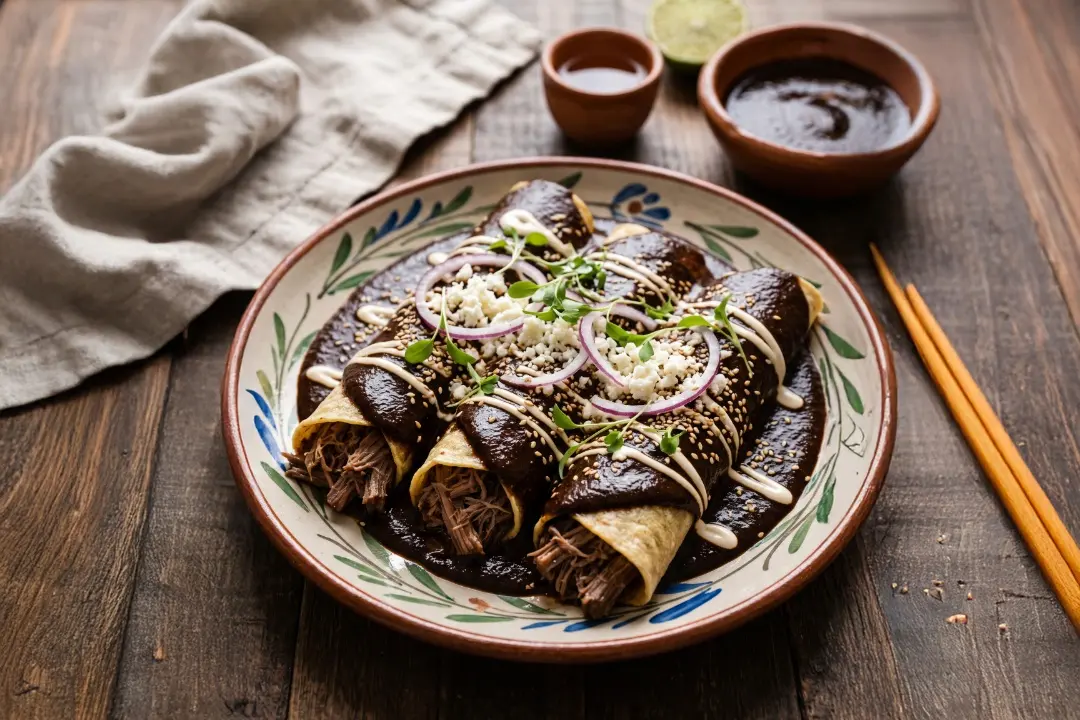
Enmoladas represent the pinnacle of Mexican comfort cuisine, elevating the humble rolled tortilla into an opulent culinary showcase. In this masterclass formulation, deeply marbled English-cut beef short ribs undergo an ultra-low, 12-hour thermal braise until their dense intramuscular collagen unspools into silken gelatin. The resulting shredded beef is wrapped in hand-pressed, lard-flashed heirloom tortillas, bathed in a glossy artisanal mole negro enriched with clarified beef braising jus, and finished with sharp, salty, and herbaceous garnishes to temper the profound richness.
Classic enmoladas coated in glossy mole. Source: Recetas Nestlé
Recipe Yield & Timing Specifications
- Yield: Serves 6 (3 filled enmoladas per serving; 18 enmoladas total)
- Active Prep Time: 1 hour 15 minutes
- Braise Duration: 12 hours (unattended low-heat braise)
- Reduction & Assembly: 30 minutes
- Total Elapsed ETA: 13 hours 45 minutes
The Science of Flavor Layering
A transcendent enmolada is an exercise in applied organic chemistry and sensory balancing. Layering flavor here requires orchestrating phase changes, molecular extractions, and enzymatic stabilization:
[Collagen Matrix] --(12h @ 200°F)--> [Gelatin Network + Rendered Lipids]
│
[Separate Mirepoix Sautéing] ──> [Fond / Deglazing] ─┴─> Rich Braising Jus
│
[Hydrophobic Spices & Chiles] ──(Emulsified with Mole Paste)───┘
│
[Velvet Mole Sauce] ──> Coats Lipophilic Tortilla
- Collagen-to-Gelatin Denaturation: Short ribs contain substantial networks of tough type-I collagen fibers. Over a 12-hour braise at a gentle 200°F (93°C), as detailed in the Serious Eats guide to collagen-to-gelatin conversion, collagen undergoes irreversible thermal hydrolysis, unraveling into gelatin peptides. This yields spoon-tender beef while infusing the braising liquid with a natural gelatinous mouthfeel that clings to tortillas without artificial thickeners.
-
Nucleotide-Glutamate Synergy: High culinary umami relies on pairing free L-glutamates with purine 5'-ribonucleotides (specifically disodium inosinate). The beef tissue provides an abundance of inosinate, which multiplies exponentially on your palate when matched with the free glutamates naturally occurring in caramelized tomato paste, toasted chiles, and cacao. Review the molecular principles at the Umami Information Center on glutamate and inosinate synergy.
-
The Physics of Independent Sautéing: Crowding raw vegetables into a single pan collapses pan temperature below 212°F (100°C), resulting in wet steaming rather than dry caramelization. Furthermore, alliums, root crops, and herbs possess distinctly disparate moisture levels, carbohydrate structures, and burning thresholds. Sautéing each aromatic vegetable independently allows you to hit the precise temperature curve for each ingredient, driving off water and creating unique aromatic pyrazines and furans.
-
Lipophilic Volatile Extraction & Emulsification: Capsaicin, cinnamaldehyde (from canela), and thymol (from oregano) are non-polar hydrophobic compounds that dissolve poorly in water but dissolve readily in fats. By bonding the rendered beef tallow with the dissolved solids of the mole paste, we form a stable culinary suspension, a concept explored in the Harvard Science and Cooking lecture on phase transitions and emulsions.
-
Balancing the Taste Axes: Mole negro delivers natural bitterness from charred chile skins and roasted cacao. High culinary technique counterbalances that bitterness by layering the mild acid of stewed tomato paste, the malic sweetness of piloncillo, and the sharp lactic acidity of salty queso cotija on top.
Step 1: Tempering and Dry Brining the Short Ribs- Pat the short ribs completely dry using lint-free kitchen towels to eliminate surface water activity, which impedes crust formation.
- Season aggressively across all surfaces with 1.5 tablespoons of kosher salt and the cracked black pepper.
- Allow the beef to temper on a wire rack at room temperature for 45 minutes. This ensures an even heat gradient during searing and promotes cellular salt absorption.
Step 2: High-Heat Maillard Crust Development- Heat a heavy enameled cast-iron Dutch oven over medium-high heat. Add 2 tablespoons of lard or avocado oil, waiting until the surface ripples and approaches the smoke point (approx. 385°F / 196°C).
- Sear the short ribs in uncrowded batches (2 to 3 pieces at a time) for 3 to 4 minutes per side until an amber-mahogany crust forms. To understand the underlying amino-acid restructuring, consult the Maillard reaction mechanisms on ScienceDirect.
- Transfer the seared ribs to a resting platter. Pour off all but 1.5 tablespoons of the rendered hot fat from the pot, leaving behind the dark fond at the base.
Step 3: Sautéing Aromatics Independently for Distinct Flavor profilesDo not combine the vegetables prior to cooking. Each requires a distinct thermal treatment to caramelize without boiling or scorching.
- The Onions (Caramelization & Sulfur Volatilization): Drop the diced yellow onion into the reserved fat over medium heat. Sauté for 6 to 8 minutes, stirring continuously, until translucent and golden along the perimeter. The goal is converting pungent sulfur precursors into sweet thiols and pyrazines. Remove the cooked onions with a slotted spoon and place them into a clean holding bowl.
- The Carrots (Sucrose Pyrolysis & Carotenoid Softening): Add the brunoise carrots to the same pot. Sauté over medium-high heat for 5 to 6 minutes until the edges take on a blistered, roasted brown hue. Carrots require high radiant heat to initiate sugar breakdown; see Harold McGee on aromatic vegetable caramelization. Transfer the carrots into the holding bowl with the onions.
- The Celery (Moisture Reduction & Herbaceous Focus): Add the celery to the dry pot with a light dash of fat if needed. Sauté over high heat for 3 minutes just until its internal moisture flashes off and the crispness yields slightly, preventing it from weeping excess water into your braise later. Transfer to the holding bowl.
- The Garlic (Low-Temperature Gentle Blooming): Turn the flame down to low. Add the shaved garlic into the pan. Stir constantly for 60 to 75 seconds until fragrant and pale ivory. Do not let it brown; toasted garlic turns acrid and will taint the delicate mole base.
- The Tomato Paste Pincé: Slide the garlic to the edge of the pot, crank the heat back to medium, and introduce the tomato paste to the bare center of the pan. Smear and fry the paste (pincé) for 2 minutes until it shifts from bright crimson to a deep rust-red brick color, indicating the caramelization of its organic acids.
Step 4: Deglazing and the 12-Hour Sub-Simmer Braise- Pour 1 cup of beef bone broth into the hot pot, scraping the bottom vigorously with a flat wooden spatula to lift the accumulated fond.
- Return the sautéed onions, carrots, celery, and garlic back into the pot.
- Nestle the seared short ribs tightly into the aromatic base. Tuck the canela stick, Mexican oregano, and bay leaves among the ribs.
- Pour in the remaining 3 cups of beef bone broth. The liquid should rise halfway to two-thirds up the sides of the meat, leaving the browned tops exposed.
- Bring the pot to a bare simmer on the stovetop, then seal it tightly with a double layer of aluminum foil topped with the heavy lid to create an airtight vapor seal.
- Transfer to an oven preheated to 200°F (93°C). Braise for 12 continuous hours. At this low temperature, meat fibers will remain tender while connective tissues fully melt. Review USDA meat preparation and safe braising temperatures for standard core temperature parameters; for this long-format culinary braise, refer to our technique tutorial on Mastering Low-and-Slow Braising.
Step 5: Separation, Shredding, and Jus Clarification- Carefully retrieve the pot from the oven. Gently transfer the short ribs to a cutting board. The bones should slide cleanly away from the meat with zero resistance; discard bones and cartilage.
- Using two forks, shred the beef into succulent ribbons. Discard large pockets of unrendered external fat, retaining the tender, juicy meat shreds. Cover with foil to keep warm.
- Strain the braising liquid through a fine-mesh chinois into a glass fat separator. Let stand for 10 minutes until the clear golden tallow rises above the deep amber jus. Reserve 3 cups of the rich bottom jus for your mole, saving the skimmed tallow for frying tortillas.
Step 6: Crafting the Velvet Mole Reduction- Place a broad saucepan over medium-low heat and warm 1 tablespoon of the rendered beef tallow.
- Add the 16 oz of mole negro paste. Cook the paste, stirring constantly, for 3 to 4 minutes to reactivate the toasted spices, seeds, and dried chiles within the concentrated paste.
- Slowly ladle in the 3 cups of reserved hot beef braising jus, whisking constantly to create a silky, lump-free emulsion.
- Drop in the dark Mexican cacao disc and grated piloncillo. Simmer gently over low heat for 12 to 15 minutes until the sauce coats the back of a spoon with glossy sheen (nappe consistency). Season with fine sea salt if necessary. Keep warm over the lowest setting.
Step 7: Flashing the Tortillas (Pasar por Aceite)Crucial Technique: Never roll cold or plain-steamed corn tortillas directly in mole—they will absorb excess moisture, lose their structure, and turn to mush. Learn how proper lime curing maintains kernel integrity via Food52 exploration of nixtamalization chemistry.
- Warm 1/3 cup of lard or neutral oil in a small skillet over medium-high heat until it shimmers (approx. 350°F / 175°C).
- Using long tongs, submerge each tortilla into the hot fat for precisely 4 to 6 seconds per side. The tortilla should soften and blister slightly without becoming rigid or crisp.
- Immediately remove the tortilla and drain for 3 seconds on wire racks or paper towels. This creates a thin hydrophobic lipid barrier that stops the corn structure from deteriorating when doused in warm sauce.
Step 8: Assembly and Plating- Working quickly, submerge a flashed tortilla entirely into the warm mole sauce using tongs, ensuring both sides are coated.
- Lay the coated tortilla flat onto a warm prep plate. Spoon approximately 2.5 tablespoons of warm, shredded 12-hour short rib meat in a neat line across the lower third of the round.
- Roll the tortilla snugly around the meat into a tidy cylinder. Place seam-side down onto your serving plate. Repeat for 3 enmoladas per portion.
- Generously ladle another 3 to 4 tablespoons of hot mole negro directly over the top of the rolled enmoladas, ensuring uniform coverage.
- Finish by dusting with crumbled Queso Cotija, scattering the paper-thin red onion rings, drizzling fine streaks of Crema Mexicana, sprinkling toasted white sesame seeds, and garnishing with micro-cilantro. Serve immediately.