
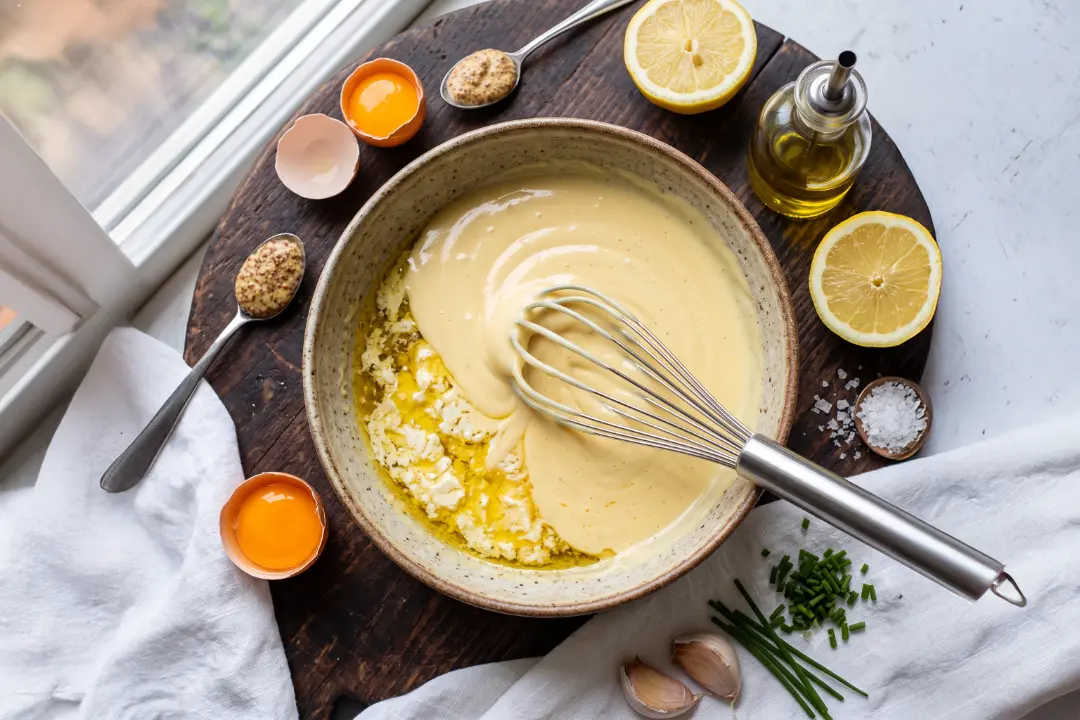
Imagine pouring warm, melted butter into a splash of wine reduction, only to watch it instantly split into a greasy puddle of oil floating over curdled pools. It is one of the most disheartening moments a cook can face. One second you have the beginnings of a luxurious masterpiece; the next, you are staring at an unappetizing kitchen disaster.
But here is the liberating truth: top-tier culinary results happen the moment you stop treating sauces like a game of luck and start viewing them as a predictable system of physics and chemistry.
When you understand the hidden mechanics operating inside your mixing bowl, cooking transitions from stressful guesswork to repeatable food science. Whether you need to rescue a broken Hollandaise on a chaotic Sunday morning, craft an ultra-stable vinaigrette for a crisp salad, or engineer a velvet-smooth mayonnaise completely from scratch, everything boils down to mastering the delicate relationship between fat and water.
Welcome to the ultimate step-by-step masterclass on sauce emulsions. In this comprehensive guide, we will pull back the curtain on the molecular science of binding immiscible (unmixable) ingredients, introduce you to nature’s most powerful culinary binders, evaluate the tools that give you maximum mechanical advantage, and walk you through an airtight, fool-proof protocol to create stable culinary emulsions every single time.
1. The Science of the Bond: What is a Culinary Emulsion?
To master the art of the sauce, we must first shrink our perspective down to the microscopic level. At its core, an emulsion is a forced alliance between two liquids that naturally repel each other: water and fat.
In their natural states, oil and water molecules will never willingly mingle. Water molecules are highly polar and form tight bonds with one another, effectively squeezing out non-polar fat molecules. To overcome this natural antagonism, we must manipulate three critical components that form the anatomy of every emulsion:
- The Dispersed Phase: This is the ingredient that gets broken down. It consists of millions of microscopic droplets of fat—such as vegetable oil, clarified butter, or rendered duck fat—that are forced to scatter throughout the sauce.
- The Continuous Phase: This is the welcoming environment. It is the water-based liquid base that suspends those tiny fat droplets. In the culinary world, this is almost always an aqueous liquid, such as vinegar, wine reductions, citrus juice, or plain water.
- The Emulsifier: This is the molecular bridge. Without an emulsifier, your dispersed fat droplets will quickly find each other, merge, and float to the top. An emulsifier consists of amphiphilic molecules. Imagine them as tiny ropes: one end is hydrophilic (water-loving) and anchors itself securely into the continuous phase, while the opposite end is lipophilic (fat-loving) and binds tightly to the fat droplets. By coating the surface of the fat droplets, emulsifiers keep them isolated, protected, and evenly suspended.
Oil in Water Emulsion: Temporary vs. Permanent Alliances
Depending on the presence and strength of your emulsifying agent, your sauce will fall into one of two distinct structural categories:
Temporary Emulsions
Think of a classic red wine vinaigrette. When you vigorously shake oil and vinegar together in a jar, you are using pure kinetic energy to tear the oil into small droplets. For a few minutes, the sauce looks uniform and opaque. However, because there is no powerful chemical emulsifier present to keep those droplets apart, gravity and molecular attraction take over. The oil droplets inevitably collide, coalesce (merge), and cause complete phase separation within minutes. Learn more about regional flavor pairings by exploring our guide to traditional Mexican salsas.
Permanent Emulsions
Think of a thick, glossy homemade mayonnaise or a decadent Béarnaise. In these systems, a powerful, permanent emulsifying agent is introduced to coat the fat droplets. Even though the fat is packed together tightly, the chemical shield prevents the droplets from ever merging back into a unified mass. A properly constructed permanent culinary emulsion will remain stable, uniform, and creamy for days, or even weeks, under correct storage conditions. For a masterclass in applying these permanent bonds to proteins, read our tutorial on perfecting duck carnitas.
2. Meet Your Binders: How Do Emulsifiers Bind Fat and Water?
You cannot expect to build stable culinary emulsions through brute force alone. You need chemistry on your side. Fortunately, nature has provided professional chefs and passionate home cooks alike with an array of highly efficient, flavor-packed emulsifying agents. To explore how these molecular principles apply to broader kitchen techniques, check out the comprehensive tutorials on The Science of Cooking by Harvard University.
Egg Yolks (Lecithin vs Mucilage in Cooking)
The undisputed heavyweight champion of the emulsion world is the humble egg yolk. Egg yolks are incredibly rich in lecithin, a powerful phospholipid that possesses an exceptional talent for stabilizing fat-in-water mixtures. Lecithin molecules rapidly wrap themselves around microscopic oil or butter droplets, creating a highly resilient protective barrier. The structural capacity of a single egg yolk is astonishing: scientifically, one yolk contains enough lecithin to successfully emulsify several gallons of oil, provided the mechanical dispersion is executed correctly. Dive deeper into the crystalline properties of lipids with the chemical deep-dives hosted by the American Chemical Society.
Mustard (The Mucilage Shield)
If you have ever wondered why a tablespoon of Dijon mustard makes your salad dressings hold together dramatically better, the answer lies in mucilage. The outer coatings of mustard seeds are packed with complex carbohydrates (mucilage) and proteins. When mixed into a continuous phase like vinegar, these compounds absorb water and swell, creating a thick, viscous network. This structural matrix physically blocks oil droplets from moving freely, making it significantly harder for them to collide and separate. Discover how to balance these acidic and structural elements in our complete local discovery guide to Cabo gastronomy.
Garlic Paste (Cellular Micro-Particles)
In traditional Mediterranean cooking, an authentic allioli or toum is made using nothing more than garlic, olive oil, salt, and citrus juice. When garlic cloves are thoroughly crushed and pulverized into a completely smooth paste, their cell walls rupture, releasing an intricate mix of structural micro-particles and natural mucilage. This creates a dense, sticky physical lattice that traps oil droplets as they are whisked into the paste, proving that mechanical structure can sometimes step in where classic chemical emulsifiers are absent.
Dairy Proteins (The Magic of Casein)
When you melt cold cubes of butter into a pan of simmering white wine to create a classical French Beurre Blanc, you are relying on dairy proteins—specifically casein—to do the heavy lifting. Whole butter is actually a highly concentrated water-in-oil emulsion (roughly 80% milkfat, 18% water, and 2% milk solids). By melting the butter slowly over low heat while constantly swirling the pan, you coax those inherent casein proteins into flipping their orientation, transforming the mixture into a smooth, luxurious oil-in-water sauce. To review industry standards on dairy composition and emulsion stability, consult the Culinary Institute of America’s Professional Resources.
3. Immersion Blender vs Hand Whisk Emulsion Shear
When it comes to preparing to construct a magnificent sauce, the tools you choose will dictate your physical workflow and your overall margin of error. Creating an emulsion requires breaking large pockets of fat down into particles measured in microns. To achieve this, you need mechanical shear.
[Large Fat Mass] —> (Mechanical Shear Force) —> [Micron-Sized Droplets]
The Case for High-Shear Tools (The Immersion Blender)
If you want to guarantee a stable emulsion with minimal physical exertion, the immersion blender is your absolute best friend. The rapidly spinning blade of a motorized blender generates an immense amount of localized kinetic energy. It creates a high-shear environment that instantly tears incoming fat into microscopic droplets that are physically incapable of finding one another to merge. Because the shearing happens at thousands of revolutions per minute, it creates an exceptionally tight, dense packing of droplets, lowering the margin of error and yielding an incredibly thick, stable sauce in seconds. For insights on how high-shear blending optimizes restaurant kitchens, browse the culinary science archives at Serious Eats.
The Traditional Path (The Balloon Whisk)
The classic balloon whisk relies entirely on your own muscle power. Because a human hand cannot match the rotational velocity of an electric motor, your success with a whisk depends heavily on a slow oil incorporation emulsion rate. Whisking requires a wider container, strategic wrist movement, and a deep understanding of when to pause the oil stream to catch up mechanically. While it offers unparalleled sensory feedback—allowing you to feel the exact moment the sauce tightens—it leaves a much narrower margin for error. If you are developing video content or tutorials around this manual technique, optimize your digital setup using our SEO and YouTube strategy guide for food channels.
4. How to Make Stable Culinary Emulsions: The Step-by-Step Protocol
Now that you understand the science, the binders, and the tools, it is time to put theory into practice. Follow this precise, linear protocol to engineer a flawless, permanent culinary emulsion every single time. Skipping or rushing any of these stages is the primary reason home sauces collapse.
1. Thermal Calibration:The Foundation of Stability.
Before any mixing begins, check the temperature of your ingredients. Warm emulsions (like Hollandaise or Béarnaise) require your fat and base liquids to stay strictly between 110°F and 140°F (43°C to 60°C). Cold emulsions (like mayonnaise) work best when egg yolks and oils are at room temperature. Cold proteins are rigid and stubborn; bringing them to room temperature relaxes the molecular chains, allowing them to stretch and wrap around fat droplets with ease.
2. Hydrate the Continuous Phase: Activating Your Binders.
Place your water-based liquid (lemon juice, vinegar, or reduction) along with your chosen emulsifier (egg yolk, mustard, or garlic paste) into the bottom of your blending jar or heavy mixing bowl. Whisk or blend this baseline mixture for 30 seconds before adding a single drop of fat. This critical step fully dissolves the emulsifying proteins and ensures they are hydrated, active, and floating freely in the continuous phase, ready to receive the fat.
3. The Micro-Stream Titration: Forming the Embryonic Seed.
This is the most critical phase of the masterclass. Begin applying maximum mechanical shear—either by running your immersion blender at high speed or whisking vigorously. Slowly introduce your oil or clarified butter drop by drop, or in a microscopic, hair-thin stream. If you dump a large volume of fat into the bowl early on, the fat molecules will easily surround and overwhelm the scarce water molecules, leading to immediate phase separation. You must wait until you see the liquid turn pale, opaque, and noticeably thick before proceeding. This indicates that your “seed” emulsion has successfully formed.
4. Steady Incorporation & Adjustment: Packing the System.
Once your embryonic seed is established and the sauce has clearly taken hold, you can safely transition from a cautious drop-by-drop pour to a thin, steady, continuous stream of fat. As you add more fat, the microscopic droplets become increasingly crowded, causing the sauce to grow progressively thicker and shinier. Pay close attention: if the sauce begins to look greasy or overly stiff, it means you are running out of water-based continuous phase. Stop pouring the fat immediately, and whisk in a single teaspoon of warm water or lemon juice to loosen the structure and replenish the continuous phase before finishing your pour.
5. Coagulation Temperature Egg Yolk Sauce: The Thermal Ceiling
While cold sauces like mayonnaise are relatively stable once built, warm emulsified sauces like Hollandaise, Béarnaise, and Beurre Blanc live in a state of constant thermodynamic peril. The primary antagonist of a warm emulsion is excessive heat. To study the precise thermodynamic behaviors of egg proteins under thermal stress, refer to the Institute of Food Technologists Research Library.
Every egg-based warm sauce has a rigid thermal ceiling: approximately 160°F (71°C).
When egg yolks are heated beyond this threshold, the proteins undergo an irreversible chemical transformation called coagulation. The protein strands lose their fluid, elastic quality and begin bonding tightly to one another, curling up into solid, rubbery, hydrophobic (water-repelling) clumps.
The moment your proteins cook into solid bits of scrambled egg, they lose their ability to act as an amphiphilic bridge. The chemical shield vanishes completely, and the suspended butter droplets are instantly released to merge into an oily, separated layer. For an breakdown of navigating thermal management in commercial settings, see our analysis of Restaurante El Brody’s kitchen systems.
The Rule of Residual Heat
To protect your delicate warm sauces from crossing this thermal boundary, you must master the rule of residual heat:
- Avoid Direct Flames: Never cook or hold a warm emulsion directly over a hot burner. The intense, uneven heat from the bottom of the pan will cook the egg proteins instantly.
- Use a Double Boiler (Bain-Marie) Cautiously: If using a bowl over simmering water, ensure the bottom of the bowl never makes physical contact with the water itself. The steam alone provides more than enough energy to heat the sauce. For a breakdown of classical French double-boiling standards, consult the Le Cordon Bleu Culinary Architecture Guides.
- The Power of Off-Heat Blending: The safest way to craft a Hollandaise is to utilize the residual heat of your fat. By heating your clarified butter to roughly 145°F (63°C) and streaming it into a room-temperature egg yolk base using an immersion blender, the butter safely cooks the yolk to a pasteurized, creamy consistency without ever risking coagulation.
6. How to Fix a Broken Butter Sauce: The Rescue Matrix
Even the most experienced chefs occasionally suffer from a broken sauce. A sudden spike in heat, a momentary lapse in your pouring cadence, or an unbalanced ratio can shatter your emulsion in the blink of an eye. Fortunately, because emulsification is a predictable physical system, a broken sauce is never a lost cause. You can easily reverse-engineer and repair the structure using this direct troubleshooting guide:
| Visible Symptom | Root Molecular Cause | Immediate Kitchen Fix |
| Greasy appearance with slick pools of oil floating on top | System Saturation: Fat was introduced too rapidly, or the volume of fat completely overwhelmed the available water in the continuous phase. | Stop adding fat immediately. Take a clean bowl and add one teaspoon of warm water (or an extra egg yolk for maximum insurance). Vigorously whisk or blend this new continuous phase while slowly pouring your broken, separated sauce into it drop-by-drop. The fresh base will easily capture the broken fat droplets and rebuild the emulsion from scratch. |
| A lumpy, curdled texture resembling watery scrambled eggs | Thermal Coagulation: The sauce exceeded 160°F (71°C), causing the egg yolk proteins to cook into solid, inflexible particles. | Pour the entire broken sauce through a fine-mesh sieve or cheesecloth to filter out the hard, scrambled protein lumps. Take the remaining smooth, separated liquid and place it into a blender jar. Add one tablespoon of warm water and blend on high speed for 30 seconds to force the uncoagulated elements back into suspension. |
| A thin, watery, translucent liquid that refuses to body up | Insufficient Shear or Under-packing: The fat was not broken down into small enough droplets, or you didn’t add enough fat to crowd the system. | If your arms are tired from a hand whisk, transfer the liquid into a high-speed blender or food processor and run it for 45 seconds to increase kinetic shear. If it remains thin, slowly stream in an extra tablespoon or two of fat; packing more droplets into the continuous phase will naturally force the sauce to thicken. |
Frequently Asked Questions
Why does pouring oil too fast break homemade mayonnaise?
If you pour oil too quickly at the start, the massive volume of fat molecules will crowd out and isolate the small amount of water molecules before they can form a unified continuous phase. Instead of forming tiny, isolated oil droplets suspended in water, the system inverts, causing the oil to coalesce into a massive, greasy puddle that completely rejects the water. To master the baseline step of sourcing the best local eggs and oils for this process, view our guide to essential Mexican gastronomy ingredients.
At what temperature does an egg-based emulsified sauce split?
An egg-based emulsified sauce will split when it crosses the coagulation threshold of approximately 160°F (71°C). At this temperature, the egg yolk proteins cook into solid clumps, losing their elasticity and their ability to chemically bind fat and water together. For advanced culinary troubleshooting, view the food chemistry breakdowns published by the Science History Institute.
Can you fix a broken emulsion without adding another egg yolk?
Absolutely. In most cases of phase separation, your emulsifying proteins are still perfectly intact; they have simply lost control of the system because the fat overwhelmed the water. You can typically rescue the sauce by placing a teaspoon of water or lemon juice into a clean bowl and slowly whisking the broken mixture into it to re-establish the proper phase ratio.
How does nixtamalization relate to emulsification properties in traditional Mexican cuisine?
While nixtamalization is primarily the process of cooking corn in an alkaline solution (lime water) to create masa, it releases free fatty acids and soluble starches. These compounds act as excellent natural stabilizers and thickeners that mirror the behavior of hydrocolloids in modern culinary emulsions. To see this traditional food science in action, explore our complete masterclass on corn nixtamalization.
Take Your Culinary Skills to the Next Level
Understanding the microscopic science of sauce emulsions transforms you from a cook who blindly follows recipes into an intuitive culinary engineer. The very same principles of fluid dynamics, temperature management, and mechanical shear that control your morning Hollandaise apply across the entire world of gastronomy.
Now that you have completed this masterclass and hold the blueprints to flawless culinary structure, it is time to put your knowledge to the test. Head into the kitchen, grab your favorite whisk or immersion blender, and confidently craft a velvet-smooth sauce from scratch. If you found this food science breakdown helpful, share this guide with your fellow kitchen enthusiasts, leave a comment below detailing your favorite sauce variation, and subscribe to our newsletter for more deep-dive culinary masterclasses delivered straight to your inbox!