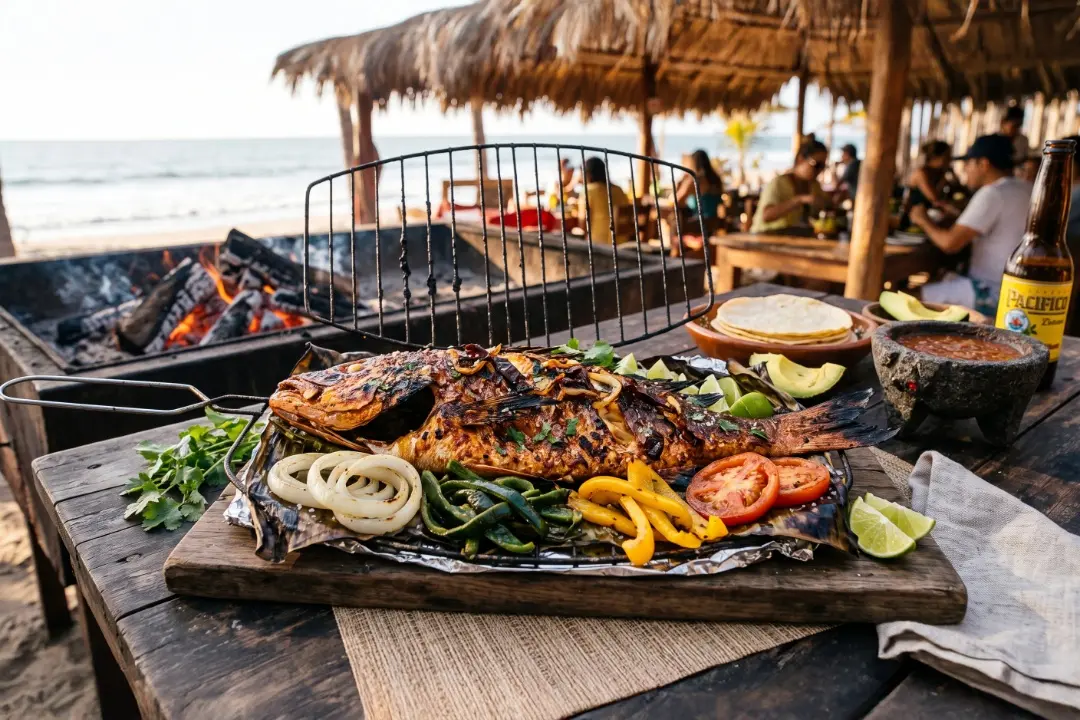
Originating along the Pacific coast of Nayarit and Sinaloa, Pescado Zarandeado is one of Mexico’s most celebrated coastal culinary preparations. A whole, fresh fish is split along the spine butterfly-style (corte mariposa), lacquered with a savory chile-and-citrus adobo emulsion, secured in a hinged wire grilling basket (zaranda), and roasted over fragrant hardwood embers. The high heat of the wood caramelizes the sugars and dried chiles on the fish’s surface while locking natural moisture inside the delicate flesh.
- Yield: Serves 4 to 6 people
- Prep Time: 35 minutes
- Marinating Time: 20 minutes
- Cook Time: 25 minutes
- Total Estimated Time (ETA): 1 hour 20 minutes
The Science of Flavor Layering
A restaurant-caliber Zarandeado balances wood smoke, savory depth, capsaicin, and sharp acid. Understanding the interplay of these chemical reactions ensures predictable mastery over the grill:
-
The Mayonnaise & Lipid Barrier: Mayonnaise functions as an egg yolk-stabilized emulsion of suspended oil droplets. When brushed onto delicate white fish, it provides an insulated moisture blanket. As detailed in food research on lipid behavior and thermal emulsion stability, fat-soluble compounds carry volatile aromatics directly across the fish cells while preventing surface moisture from evaporating prematurely under radiant heat.
-
Nucleotide & Free Amino Acid Synergism: Guajillo and ancho chiles provide complex fruity bitterness and earthy tannins. Blending these dried chiles with fermented condiments (Worcestershire and Jugo Maggi) exploits glutamate-inosinate umami synergy. Glutamates from the soy/fermentation bond with naturally occurring inosinate monophosphates (IMPs) present in marine muscle tissue, magnifying savoriness up to eightfold compared to salt alone.
-
Wood Pyrolysis and Smoke Deposition: Cooking over seasoned wood embers (preferably oak, mesquite, or mangrove wood) releases phenolic molecules through lignin breakdown. As explored in studies on wood combustion and volatile phenolic compounds, volatile syringol provides traditional woodsmoke aroma, while guaiacol imparts sweet, spicy undertones. These aromatic phenols absorb into the warm lipid glaze on the fish's flesh.
-
Surface Dehydration & Maillard Browning: The open butterfly cut creates an expansive surface-to-volume ratio. High radiant heat from the glowing charcoal rapidly vaporizes water droplets on the exterior, initiating the science of the Maillard reaction between the fish's natural amino acids and the reducing sugars in the orange juice, onions, and chiles.
-
Organic Acid Balance: Marine fish possess rich structural collagen and gelatin. Fresh Mexican lime juice, cider vinegar, and orange juice bring citric and acetic acid to cleave fat molecules on the palate, ensuring each bite feels bright rather than greasy.
Step 1: Fish Butchery and Surface ConditioningSelect an exceptionally fresh specimen following sustainable NOAA FishWatch profile for red snapper metrics (firm, resilient flesh, bright red gills, and clear, convex eyes).
- Lay the scaled and gutted fish on a stable board. Using a stiff boning knife, slice lengthwise along the spine from the collar to the tail, cutting through the rib cage on one side while leaving the belly skin fully intact.
- Open the fish flat like a book. Split the center of the head with a cleaver so it lies completely level on the work surface. Review fundamental techniques for butterflying a whole fish if working with whole fish for the first time.
- Pat the flesh thoroughly dry using paper towels to remove all surface moisture. Score the thickest portions of the loin in a diamond pattern, 1/4-inch deep.
- Season evenly across the meat with coarse sea salt, cracked black pepper, and lime juice. Rest refrigerated for 15 minutes.
Step 2: The Adobo Emulsion- Stem, seed, and toast the guajillo and ancho chiles on a hot, dry griddle (comal) for 10 to 15 seconds per side until fragrant; do not let them blacken. For a deeper breakdown of selecting pods, consult our comprehensive Mexican dried chili guide.
- Transfer the chiles to a bowl of hot water; soak for 15 minutes until softened, then drain.
- In a high-speed blender, combine the softened chiles, chopped white onion, garlic cloves, orange juice, apple cider vinegar, oregano, and cumin. Purée on high for 90 seconds until silky smooth. Strain through a fine-mesh sieve to remove residual skins.
- Pour the strained chile purée into a bowl. Whisk in the mayonnaise, melted butter, yellow mustard, Worcestershire sauce, and Jugo Maggi until a glossy, emulsified adobo forms. Similar principles apply across various scratch-made adobo bases.
- Generously coat the flesh side of the butterflied fish with two-thirds of this adobo. Allow it to marinate at cool room temperature for 20 minutes. Reserve the remaining adobo for basting.
Step 3: Sautéing the Vegetable Garnishes IndividuallyIn traditional coastal kitchens, vegetables are often piled raw onto the fish before grilling, which frequently yields uneven textures and trapped moisture. Sautéing each vegetable separately in a dedicated pan ensures precise Maillard browning and texture control. Use a heavy cast-iron skillet, applying the rules of proper cast-iron seasoning and heat retention.
- The White Onions: Heat 1/2 tablespoon of lard or oil in your skillet over medium-high heat. Add the onion rings in a single layer. Sear untouched for 2 minutes to obtain blistered, translucent edges while preserving a crisp central core. Remove to a warm platter; season lightly with salt.
- The Poblano Chiles: Wipe the skillet clean, add 1/2 tablespoon of oil over medium heat, and toss the roasted poblano rajas. Sauté for 2 to 3 minutes until tender and glossy without breaking down their structural skin. Transfer to the platter.
- The Bell Peppers: Add 1/2 tablespoon of oil over high heat. Add the sweet bell pepper strips and toss quickly for 90 to 120 seconds. The goal is a flash-sear that caramelizes the exterior while preserving internal turgor and snap. Remove from heat.
- The Roma Tomatoes: Lower heat to medium-low and add the final 1/2 tablespoon of oil. Place the thick tomato slices in the pan. Sauté for exactly 60 seconds on the first side and 45 seconds on the second side. Do not let them turn mushy; pull them while the rounds maintain structural integrity.
Step 4: Grill Setup and Ember Management- Build a two-zone hardwood charcoal and wood chunk fire (preferably seasoned red oak, mesquite, or pecan) inside an open kettle or drum grill.
- Allow the logs to burn down into glowing embers banked predominantly to one side. Aim for a medium-high ambient cooking zone of approximately 375°F to 400°F (190°C to 204°C).
- Thoroughly coat a heavy hinged wire fish basket (zaranda) with neutral oil or lard to prevent sticking.
- Place the marinated fish flat inside the basket, skin side facing down against one half, and close the latch securely.
Step 5: Grilling and Basting Technique- Place the basket over direct medium-high embers with the flesh side facing downward toward the coals first. Cook directly for 3 to 4 minutes. This flash-sears the adobo, setting the proteins and creating caramelized grill marks.
- Carefully flip the zaranda so the skin side faces downward toward the coals. Move the basket slightly toward the cooler, indirect heat zone.
- According to Harold McGee's heat transfer principles, whole fish on the bone with skin acts as an efficient heat sink: the skin and spine protect the delicate meat while conducting heat evenly from underneath.
- Generously brush the reserved adobo sauce across the exposed flesh. Close the grill lid (or tent lightly with foil if using an open pit) and cook for 14 to 18 minutes over indirect wood heat.
- In the final 3 minutes of cooking, arrange the individually sautéed onions, poblanos, peppers, and tomato rounds directly across the hot, sauced flesh of the fish to reheat and marry flavors.
- Verify doneness using an instant-read probe thermometer inserted into the thickest shoulder segment away from the spine. Conform to FDA guidelines on safe internal cooking temperatures, removing the fish once it registers 135°F to 140°F (57°C to 60°C); carryover thermal momentum will bring it to an optimal, flaky 145°F (63°C).
Step 6: Presentation and Service- Unlatch the wire zaranda carefully. If the skin adheres slightly, slide a thin fish spatula along the wire rungs to release it cleanly.
- Transfer the entire butterflied fish on its crisp skin onto a large wooden board or platter lined with charred banana leaves or foil.
- Garnish the perimeter with sliced avocado, fresh lime wedges, and cilantro.
- Serve family-style in the center of the table alongside piping-hot fresh heirloom corn tortillas and a rustic molcajete-crushed salsa roja. Diners can scoop flakes of savory fish, caramelized vegetables, and crispy skin directly into tortillas.