
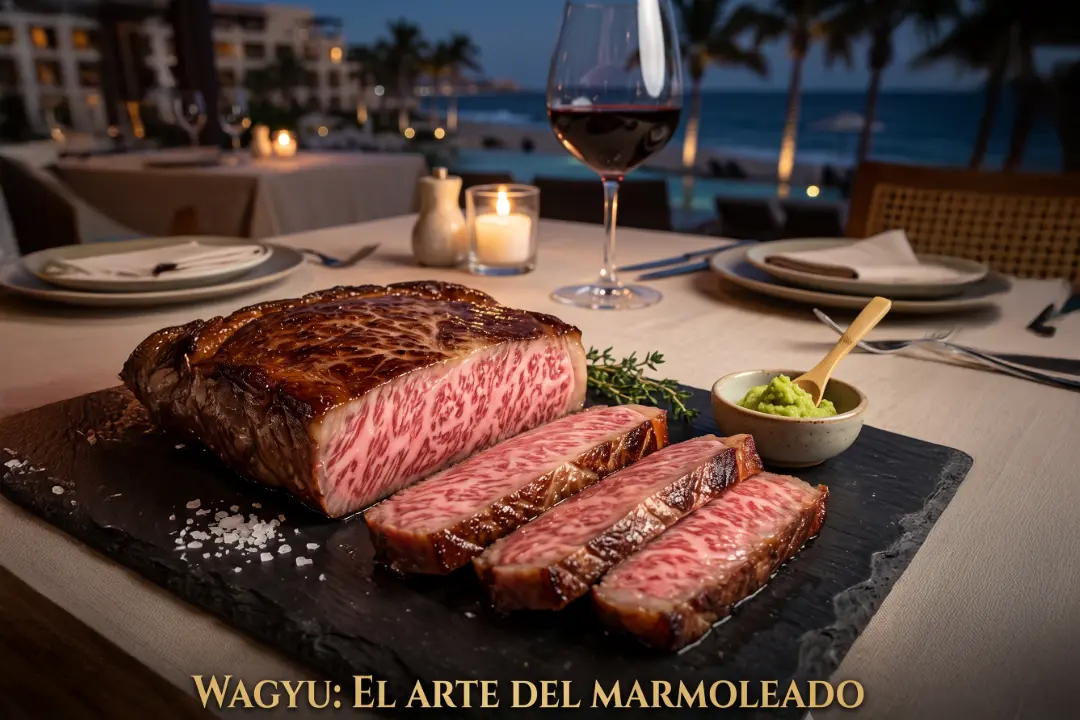
Imagine taking a bite of steak so tender it dissolves on your tongue, releasing a rich, buttery, umami flavor unlike anything you have ever tasted. That isn’t just dinner—it is a bucket-list culinary experience.
If you are a fine-dining enthusiast, luxury traveler, or curious home chef, you have likely seen terms like “A5,” “BMS 12,” and “Japanese Wagyu” on high-end steakhouse menus. But beyond the price tag, what do these numbers mean? Is an A5 steak always better than an A4? And what makes a Beef Marbling Score of 12 so extraordinarily rare?
While many food lovers recognize that “A5” represents top-tier quality, few understand the rigorous grading scale behind it: the Beef Marbling Score (BMS).
This guide breaks down the Japanese Wagyu grading system step by step. You will learn how the Japan Meat Grading Association evaluates world-class beef, how A5 marbling compares to USDA Prime, how to choose between BMS 8 and BMS 12, and how to cook this legendary ingredient so every bite lives up to the hype.
1. Decoding the Acronyms: What Does “A5” Actually Mean?
To understand Wagyu, you must first understand how Japan evaluates its beef. Unlike Western grading systems that focus mainly on marbling and age, the Japan Meat Grading Association (JMGA) uses a strict dual-axis system. Every carcass receives a letter (A, B, or C) and a number (1 through 5).
Understanding the distinction between this letter and number is the key to knowing what you are paying for.
┌─────────────────────────────────────────┐
│ JAPAN MEAT GRADING ASSOCIATION (JMGA) │
└────────────────────┬────────────────────┘
│
┌─────────────────┴─────────────────┐
▼ ▼
YIELD GRADE (Letter: A-C) QUALITY GRADE (Number: 1-5)
• Usable meat ratio • Beef Marbling Score (BMS)
• Grade A = 72%+ yield • Meat Color & Brightness
• Processor/Rancher metric • Texture & Firmness
• Fat Luster & Quality
The Yield Grade (Letters A–C)
The letter in “A5” represents the Yield Grade—a metric used by inspectors to measure the percentage of usable meat obtained from the carcass:
- Grade A: Above average (72% or higher usable meat yield).
- Grade B: Average (69% to 71% usable meat yield).
- Grade C: Below average (Under 69% usable meat yield).
What this means for your plate: Yield Grade matters most to cattle ranchers and processors because it measures carcass efficiency. While a Grade A rating guarantees the animal was exceptionally well-raised, the letter alone does not tell you how the steak tastes. For flavor and texture, look at the number.
The Quality Grade (Numbers 1–5)
The number in “A5” represents the Quality Grade, scored on a scale from 1 to 5 across four characteristics:
- Beef Marbling Score (BMS): The density and distribution of intramuscular fat.
- Meat Color and Brightness: Evaluated using official visual color standards.
- Meat Firmness and Texture: Assessing the grain, tightness, and moisture retention of the muscle.
- Fat Color, Luster, and Quality: Evaluating the purity and whiteness of the fat layers.
The “Lowest Score” Rule
The JMGA enforces an exceptionally strict rule: a carcass’s final Quality Grade is determined by its lowest individual score among the four criteria.
If a Wagyu carcass scores a 5 in marbling, fat luster, and texture, but receives a 4 in meat color, its final grade is automatically capped at A4. This rule guarantees that any steak stamped with an A5 rating is flawless across every metric.
2. The Heart of A5: Understanding the Beef Marbling Score (BMS 1 to 12)
While the Quality Grade spans numbers 1 through 5, the core of Wagyu evaluation lies within a dedicated sub-scale: the Beef Marbling Score (BMS). This scale runs from 1 (no visible marbling) to 12 (maximum theoretical marbling).
[ BMS 1 ─── BMS 2 ─── BMS 3 ─── BMS 4 ─── BMS 5 ─── BMS 6 ─── BMS 7 ]
└───────────────────────── Quality Grades 1 to 4 ───────────────────┘
[ BMS 8 ─────────── BMS 9 ─────────── BMS 10 ─────────── BMS 11 ─────────── BMS 12 ]
└──────────────────────────────── GRADE A5 ONLY ───────────────────────────────────┘
To earn a Grade 5 rating (qualifying as A5), a Wagyu carcass must achieve a minimum BMS score of 8.
This creates distinct sub-tiers of luxury within A5 Wagyu, spanning from BMS 8 to the legendary BMS 12:
| A5 Sub-Tier | BMS Range | Intramuscular Fat (IMF %) | Visual Appearance | Culinary Character |
| High-End A5 | BMS 8 – 9 | ~25% – 35% | Dense, web-like fine white fat over bright pink muscle. | Balanced Wagyu profile; rich and buttery while retaining classic steak structure. |
| Ultra-Luxury A5 | BMS 10 – 11 | ~35% – 45% | Frosted appearance where white fat dominates the surface. | Intensely rich, velvety mouthfeel; renders almost instantly. |
| The Holy Grail | BMS 12 | ~45% – 50%+ | Snow-white fat distribution; pink muscle is barely visible. | The top 0.5% of Japanese cattle; pure melt-in-your-mouth luxury served in micro-portions. |
BMS 8–9: The Balanced Masterpiece
Many executive chefs consider BMS 8–9 the sweet spot for a main course. At this level, intramuscular fat makes up 25% to 35% of the muscle structure. You get the signature silky texture and umami depth of Japanese Wagyu, but the meat retains enough muscle integrity to be enjoyed as a full 3-to-4-ounce portion. Explore our guide to tasting menu portioning to see how top chefs balance these rich cuts.
BMS 10–11: The Decadent Connoisseur Tier
A BMS score of 10 or 11 enters ultra-luxurious territory. The meat takes on a frosted, pale-pink hue due to the staggering concentration of fine, lace-like fat (shimofuri). At this tier, the fat renders at room temperature, coating the palate in a rich, savory creaminess.
BMS 12: The Rare 0.5% Zenith
BMS 12 is the absolute ceiling on the Japanese grading chart. Achieving this score is an extraordinary rarity: fewer than 0.5% of all graded Japanese Black (Kuroge Washu) cattle ever reach BMS 12.
At this tier, intramuscular fat can exceed 50% of the cut’s total weight. The meat appears almost snow-white. It isn’t eaten like a standard steak; instead, chefs serve it as delicate shabu-shabu slices, seared nigiri, or 1-ounce teppanyaki bites. Check out our A5 Wagyu teppanyaki preparation tutorial for step-by-step techniques.
3. A5 Wagyu vs. USDA Prime: Comparing Global Grading Scales
To appreciate the density of A5 Wagyu marbling, compare it directly against America’s highest beef tier: USDA Prime.
The United States Department of Agriculture (USDA) grades beef into three primary consumer tiers: Select, Choice, and Prime. USDA Prime represents the top 2% to 3% of American beef, reserved for cuts with the highest marbling.
However, when mapped onto the Japanese scale, USDA Prime tops out at roughly BMS 4 to 5.
COMPARE THE MARBLING SCALES:
USDA Choice ────────► [ BMS 2 – 3 ]
USDA Prime ────────► [ BMS 4 – 5 ] ◄── (Top 2-3% of US Beef)
A4 Wagyu ────────► [ BMS 5 – 7 ]
A5 Wagyu ────────► [ BMS 8 – 12 ] ◄── (Starts WHERE USDA PRIME ENDS!)
This means entry-level A5 Wagyu (BMS 8) begins at nearly double the marbling density of top-tier USDA Prime.
Global Marbling Comparison Chart
| Grading Body | Country | Top Designation | Equivalent BMS | Approx. IMF % | Key Characteristics |
| JMGA | Japan | A5 (BMS 12) | BMS 12 | 45% – 50%+ | Full-blood Kuroge Washu; extreme marbling, low-melting fat. |
| JMGA | Japan | A5 (BMS 8–11) | BMS 8–11 | 25% – 45% | Ultra-luxury Japanese Wagyu; intensely rich and buttery. |
| JMGA | Japan | A4 | BMS 5–7 | 18% – 25% | High marbling; excellent balance of deep beef flavor and tenderness. |
| AUS-MEAT | Australia | Marbling Score 9+ | BMS 7–9 | 15% – 25% | Australian-raised Wagyu crossbreds or full-bloods; rich and hearty flavor. |
| USDA | United States | Prime | BMS 4–5 | 8% – 12% | Top tier of US grain-fed beef; bold iron flavor with a firm bite. |
While USDA Prime delivers a robust “steakhouse” flavor with a chewiest bite, A5 Wagyu offers an entirely different sensory experience focused on velvet tenderness and delicate, sweet-savory fats. Read our breakdown on A5 Wagyu vs. American Wagyu crossbreds to understand how domestic genetics perform against purebred Japanese stock.
4. The Chemistry of Flavor: Why A5 Fat Melts at Room Temperature
Why does A5 Wagyu feel silky on the tongue compared to standard steak fat? The answer comes down to fatty acid composition and melting points.
The Power of Oleic Acid
Standard cattle fat consists primarily of saturated fats with high melting points. Full-blood Japanese Wagyu cattle, however, are genetically predisposed to convert saturated fats into monounsaturated fatty acids—specifically oleic acid (the same heart-healthy fatty acid found in olive oil).
- Oleic Acid Concentration: A5 Wagyu fat contains up to 55% to 60% oleic acid, compared to 35% to 40% in conventional beef.
- Low Melting Point: Because of this unique lipid structure, A5 Wagyu fat melts at 77°F to 80°F (25°C to 27°C).
Why this matters: Human body temperature averages 98.6°F. Because A5 Wagyu fat renders under 80°F, it literally melts from a solid to a silky liquid the moment it touches your tongue. Standard beef fat, which melts at 100°F+, requires active chewing and heat to break down. Refer to research published in the Journal of Animal Science for detailed studies on Wagyu fatty acid profiles.
FAT MELTING TEMPERATURE COMPARISON
Standard Beef Fat: 100°F – 105°F [Requires high heat & chewing]
Human Body Temp: 98.6°F [Baseline in your mouth]
A5 Wagyu Fat: 77°F – 80°F [MELTS INSTANTLY ON THE TONGUE]
The Aroma of Excellence: Wagyu-ko
When chefs sear high-BMS A5 beef, rendering oleic acid combines with specific amino acids to create a distinct coconut-and-peach-like aroma known in Japan as Wagyu-ko (Wagyu beef aroma). Learn more about sensory meat science through the American Meat Science Association (AMSA).
5. Buying & Dining Guide: Selecting Authentic A5 Wagyu
Whether you are ordering at a high-end resort steakhouse or buying cuts from a specialty butcher, evaluating A5 Wagyu requires a trained eye.
Matching BMS Scores to the Meal
- For a Standalone Steak Course (BMS 8–9): Choose this tier if you want a 3-to-4-ounce portion as a main meal. You get a rich, tender steak that retains traditional protein texture.
- For Multi-Course Tasting Menus (BMS 10–12): Ideal for chef’s tasting menus, tapas, teppanyaki, or hot-stone preparations. Keep serving sizes to 1 to 2 ounces per person to prevent palate fatigue. Explore our expert guide to wine pairings for A5 Wagyu to complement these rich cuts.
How to Verify Authenticity
Because “Wagyu” is a popular marketing term, sellers sometimes label domestic crossbred beef simply as “A5 Wagyu.” True Japanese A5 Wagyu must originate from full-blood Kuroge Washu cattle born, raised, and harvested in Japan under JMGA oversight.
Look for these three verification markers:
- The 10-Digit Identification Number: Inspectors assign every head of authentic Japanese Wagyu a unique 10-digit tracking code. Verify this number through the National Livestock Breeding Center (NLBC) database to trace the animal’s lineage, farm location, and harvest details.
- The Official JMGA Certificate & Noseprint: Authentic imports carry an official certificate featuring the JMGA seal and an individual ink noseprint of the cow.
- Realistic Pricing: Due to export tariffs, cold-chain air freight, and rarity, authentic imported A5 Wagyu commands premium prices. If a menu advertises a “12oz A5 Wagyu Steak for $50,” it is almost certainly domestic crossbred beef. Expect to pay $30 to $60+ per ounce at fine-dining establishments.
6. Culinary Preparation: How to Cook A5 Wagyu at Home
Cooking A5 Wagyu BMS 10–12 at home doesn’t require complex culinary equipment. Because A5 fat renders quickly, cooking it is remarkably simple if you follow four basic rules.
[ STEP 1 ] ──► Slice cold steak into 1/2-inch thick strips.
[ STEP 2 ] ──► Preheat cast-iron skillet to high heat (No oil needed!).
[ STEP 3 ] ──► Sear 30–45 seconds per side for a dark crust.
[ STEP 4 ] ──► Rest 3 minutes; finish with flaky sea salt & wasabi.
Rule 1: Skip the Added Oil or Butter
A5 Wagyu contains all the fat it needs inside its muscle fibers. Adding butter or cooking oil to the pan will drown the meat and produce excessive smoke. Simply trim a tiny sliver of fat from the edge of the steak, render it in a hot pan for 5 seconds, and lay the meat down.
Rule 2: Cook in Strips, Not Whole Steaks
Never place a whole 12-ounce A5 Wagyu steak into a pan at once. Instead, slice the cold steak into small strips (roughly 1/2-inch thick by 2 inches wide). Slicing allows you to flash-sear each piece at high heat while keeping the center rare and tender.
Rule 3: High Heat, Flash Sear
Because A5 fat renders at 77°F, your goal is to quickly caramelize the exterior while keeping the center warm and medium-rare.
- Preheat a heavy cast-iron skillet or stainless-steel pan over high heat until smoking.
- Place your Wagyu strips in the pan.
- Sear for 30 to 45 seconds per side.
- Remove immediately and rest on a warm plate for 2 to 3 minutes.
Rule 4: Keep Seasonings Minimal
Avoid heavy rubs, marinades, or sugary barbecue sauces. Pair A5 Wagyu with clean condiments that balance its richness, such as premium sea salt sourced from artisanal producers like Maldon Salt. Browse our essential Wagyu pan-searing tools and skillet recommendations to prepare your kitchen.
Frequently Asked Questions (FAQs)
What is the main difference between A4 and A5 Wagyu?
The primary difference is the Beef Marbling Score (BMS). A4 Wagyu receives a BMS score of 5, 6, or 7, while A5 Wagyu must achieve a BMS score of 8, 9, 10, 11, or 12. While A4 offers a rich, balanced steak experience with noticeable beef flavor, A5 provides an incomparably soft, melt-in-your-mouth texture.
Is BMS 12 Wagyu better than BMS 8 Wagyu?
It depends on your personal preference and dining format. BMS 12 represents the pinnacle of rarity with over 45% intramuscular fat, making it best suited for 1-to-2-ounce tasting portions. BMS 8 contains slightly more lean protein structure, making it ideal if you prefer a richer steak course you can enjoy as a 3-to-4-ounce serving.
Is Kobe beef the same thing as A5 Wagyu?
All Kobe beef is Japanese Wagyu, but not all Japanese Wagyu is Kobe beef. “Wagyu” refers to the specific Japanese cattle breed (Kuroge Washu). “Kobe” is a protected regional designation managed by the Kobe Beef Marketing & Distribution Promotion Association. To earn the Kobe label, the animal must be a purebred Tajima-lineage bullock or steer raised exclusively in Hyogo Prefecture, processed at designated facilities, and achieve an A4 or A5 quality grade with a BMS of 6 or higher.
Can you cook A5 Wagyu on an open outdoor grill?
You should not cook A5 Wagyu over an open grill or charcoal grate. Because the fat renders rapidly at low temperatures, dripping fat will cause intense flare-ups. These flare-ups can char the exterior, leave soot on the meat, and waste the precious rendered fat. Always cook A5 Wagyu on a flat, solid surface like a cast-iron skillet or flat-top griddle.
How much A5 Wagyu should I serve per person?
Because A5 Wagyu contains high levels of rich intramuscular fat, standard 8-to-12-ounce steak portions will quickly overwhelm the palate. The ideal serving size is 2 to 4 ounces per person for a main course, or 1 to 2 ounces per person when serving it as part of a multi-course tasting menu.
Discover World-Class Culinary Excellence
Understanding A5 Wagyu marbling scores transforms a luxury meal from a high-end splurge into an intentional culinary journey. Whether you are tasting a BMS 12 sample on vacation, dining at a premier steakhouse, or sourcing certified cuts for an occasion at home, knowing how to navigate the BMS scale ensures you appreciate every bite.
Have you tasted authentic A5 Wagyu? What BMS score or preparation style did you enjoy most?
- Share this guide with fellow steak lovers and foodies to help them navigate Japanese Wagyu grading!
- Subscribe to our culinary newsletter below for more expert dining guides, chef interviews, and insider restaurant reviews.