
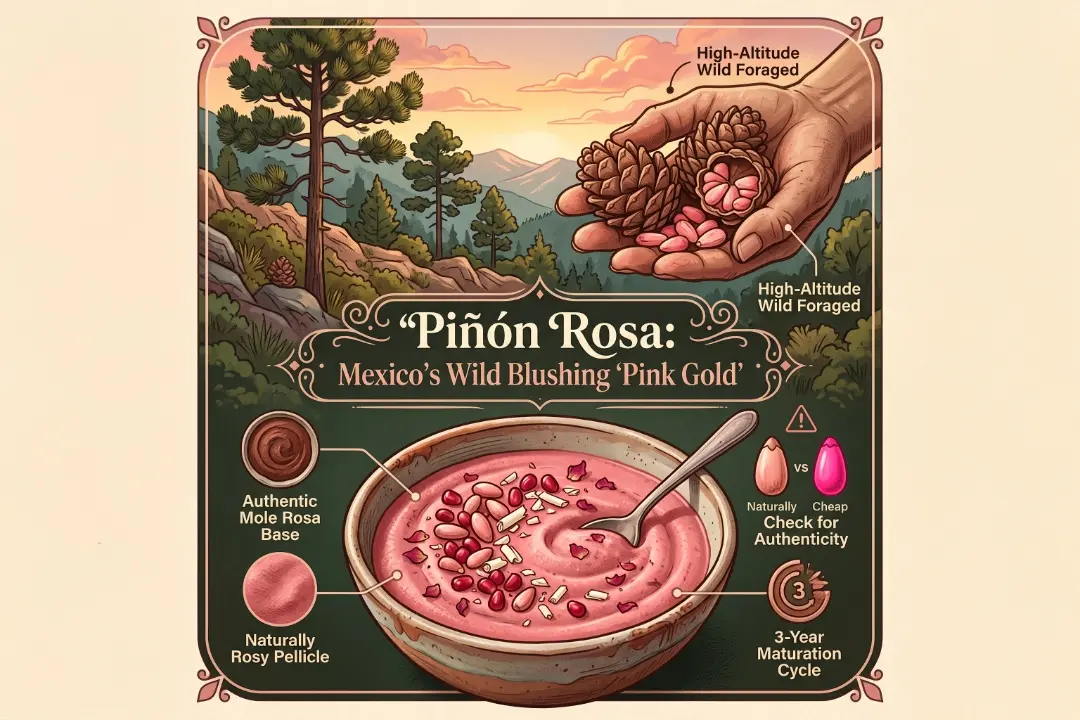
Wild pink pine nuts rank among the most expensive edible seeds in the world, fetching higher market prices per pound than vanilla beans or single-origin cacao. Foragers hand-harvest these rare seeds across the rugged, high-altitude mountain ranges of central and northern Mexico, where each pine cone requires three full years to mature.
Pink pine nuts (piñón rosa) are rare, edible seeds harvested from wild Mexican pinyon pines (Pinus cembroides). Known for their natural rose-colored skin, high oil content, and creamy, floral flavor, they serve as a core ingredient in traditional Mexican gastronomy, including Mole Rosa de Taxco.
Despite high culinary demand, the global market contains mislabeled imports, chemically treated seeds, and synthetic counterfeits. Understanding how these seeds grow, how they behave in the kitchen, and how to verify their authenticity ensures you get true wild piñón rosa.
What Are Pink Pine Nuts? Botanical Origins and Regional Terroir
Pink pine nuts are the edible seeds of wild pinyon pines native to Mexico and the southwestern United States. The primary botanical source is Pinus cembroides on Plants of the World Online (Mexican pinyon), documented by CONABIO (Comisión Nacional para el Conocimiento y Uso de la Biodiversidad) alongside regional endemic species like Pinus pinceana (weeping pinyon) and Pinus maximartinezii (Martínez pinyon).
These slow-growing trees thrive in rocky, semi-arid scrublands at elevations between 1,600 and 2,800 meters (5,200 to 9,200 feet). The primary harvesting zones include:
- Zacatecas and San Luis Potosí: The historic core of wild pinyon collection in the central-northern Altiplano.
- Hidalgo and Querétaro: High semi-desert valleys that supply central Mexican markets.
- Coahuila, Durango, and Chihuahua: Northern mountain woodlands where pinyon stands prevent soil erosion and desertification.
The Anatomy of the Rose Pellicle
The pink pigment does not originate inside the nut meat. The inner endosperm—the edible kernel—is creamy ivory.
The color comes entirely from the integument (pellicle), a paper-thin skin encasing the raw kernel inside its outer shell. This natural skin ranges from soft blush to deep dusty rose. It contains protective polyphenols and tannins that shield the seed’s delicate fatty acids from intense high-altitude sunlight. Eaten raw or gently warmed, the pellicle adds a faint floral astringency that cuts through the kernel’s rich fat content.
Pink Pine Nuts vs. White, Chinese, and Siberian Varieties
Roughly 20 pine species produce harvestable seeds worldwide, but their culinary and physical properties vary significantly across regions.
| Metric / Characteristic | Mexican Pink Pine Nut (Pinus cembroides) | Mediterranean Stone Pine (Pinus pinea) | Chinese Cedar Pine (Pinus koraiensis) | Siberian Cedar Pine (Pinus sibirica) |
| Native Region | Mexico & US Southwest | Southern Europe / Mediterranean | Northern China, Korea, Russia | Siberia, Russia & Mongolia |
| Pellicle / Skin Color | Natural rose-pink to dusty mauve | Ivory-white (skin sheds in processing) | Pale beige to light yellow | Dull tan to light brown |
| Kernel Shape & Size | Small, teardrop (8–12 mm) | Long, slender (14–18 mm) | Short, plump triangle (10–14 mm) | Small, dense oval (6–9 mm) |
| Fat (Lipid) Content | 58% – 65% | 45% – 50% | 55% – 62% | 50% – 58% |
| Flavor Profile | Sweet cream, pine resin, floral tannins | Mild, sweet, herbal, light grassy notes | Pungent, oily, strong pine resin | Earthy, woody, mild sweetness |
| Harvest Method | 100% Wild manual foraging | Managed groves & wild stands | Commercial wild harvesting | Commercial wild collection |
| Risk of “Pine Mouth” | Zero | Zero | Moderate to High (P. armandii) | Low |
| Average Retail Price (USD) | $70 – $140+ / kg | $45 – $75 / kg | $25 – $40 / kg | $30 – $50 / kg |
Why Pink Pine Nuts Cost More: The 3-Year Harvest and Masting Cycles
Raw, shelled pink pine nuts sell for $1,200 to $2,400+ MXN per kilogram (approx. $70 to $140+ USD/kg). As detailed in forestry assessments by CONAFOR (Comisión Nacional Forestal), this pricing reflects rigid biological timelines, erratic climate conditions, and demanding manual labor in managing wild non-timber forest products in Mexico.
THE 3-YEAR PINUS CEMBROIDES HARVEST LIFECYCLE
SPRING (YEAR 1) WINTER (YEAR 2) AUTUMN (YEAR 3) WINTER (YEAR 3–4)
┌───────────────┐ ┌───────────────┐ ┌───────────────┐ ┌─────────────────┐
│ Pollination │ ───► │ Dormancy │ ───► │ Cone Growth │ ───► │ Manual Harvest │
│ Tiny female │ │ Conelets stay │ │ Rapid resinous│ │ Hooking, drying,│
│ conelet forms │ │ small, green │ │ expansion │ │ cracking shells │
└───────────────┘ └───────────────┘ └───────────────┘ └─────────────────┘
▲
│
[ MASTING CYCLE: HEAVY HARVEST OCCURS ONLY ONCE EVERY 3 TO 7 YEARS ]
The 36-Month Maturation Timeline
Commercial orchard nuts like almonds, walnuts, and pecans develop on annual cycles. Pinus cembroides requires nearly three full years:
- Year 1 (Spring Pollination): Wind pollinates tiny female conelets.
- Year 2 (Dormancy): The pollinated conelet overwinters as a hard, green bud.
- Year 3 (Fertilization & Expansion): Fertilization occurs 12 to 14 months after pollination. The cone expands rapidly through the summer and produces a thick, protective resin.
- Autumn of Year 3 (Harvest): Cones turn woody and open between October and January.
Irregular Masting Cycles
Pinyon pine forests do not produce consistent yearly crops. The trees synchronize their reproduction, triggering a heavy crop—known as a mast year—only once every 3 to 7 years. Several vulnerable pinyon species listed on the IUCN Red List of Threatened Species experience severe yield swings due to changing rainfall patterns.
During off-years, yields drop by up to 90% while the trees recover carbohydrate reserves and manage moisture deficits. A single mature tree may yield 15 kg of cones in a mast year, followed by several consecutive years producing under 1 kg.
Manual Foraging and Artisanal Shelling
Harvesters cannot operate mechanical tree shakers on steep, rocky volcanic slopes. The entire supply chain relies on manual collection:
- Field Collection: Harvesters (pinaleros) use long poles with iron hooks to pull down sticky cones without breaking younger branches carrying future conelets.
- Sun Curing: Harvesters spread cones across outdoor drying beds (asoleaderos) for 7 to 15 days until sunlight opens the scales to release the seeds.
- Controlled Cracking: The thick, woody outer shell requires calibrated cracking. Aggressive industrial processing strips away the fragile pink pellicle, leaving only plain white seed fragments.
Yield Factor: Extracting 3.5 to 5 kg of clean pink kernels requires 100 kg of fresh pine cones.
Spotting Counterfeits: How to Test for Authentic Pink Pine Nuts
The price gap between Mexican piñón rosa and bulk imported white nuts encourages widespread adulteration. Bakeries and street vendors frequently use white pine nuts or blanched peanuts dyed with synthetic colorants (Allura Red AC / Red 40, carmine, or beet extract) to mimic authentic seeds.
AUTHENTICITY VERIFICATION FLOWCHART
[ EXAMINE SEED UNDER NATURAL, BRIGHT LIGHT ]
│
┌───────────────────┴───────────────────┐
▼ ▼
[ UNIFORM NEON MAGENTA ] [ SUBTLE SALMON TO DUSTY ROSE ]
│ │
▼ ▼
❌ SYNTHETIC DYE DETECTED [ DAMP PAPER TOWEL RUB TEST ]
│
┌────────────────┴────────────────┐
▼ ▼
[ INK BLEEDS ONTO PAPER ] [ PAPER REMAINS CLEAN ]
│ │
▼ ▼
❌ WATER-SOLUBLE DYE DETECTED ✅ BOTANICAL PINUS CEMBROIDES
Follow these four diagnostic steps to verify raw, unadulterated Pinus cembroides:
- Check Color Variation: Real pink pine nuts show natural gradient shifts from soft salmon to dusty mauve, with small cream patches where shelling abraded the skin. Uniform, bright neon pink indicates synthetic dye.
- Run the Damp Towel Test: Wrap 5 to 10 nuts in a damp white paper towel and press firmly for 30 seconds. Natural pigments stay locked within the plant skin; synthetic dyes immediately bleed red or pink onto the towel.
- Drop in Warm Water: Place a handful of nuts into a cup of warm water. Real pink pine nuts keep their hue and leave the water clear. Artificially dyed nuts release water-soluble dyes, clouding the liquid pink within 60 seconds.
- Taste for Texture and Resin: Real piñón rosa melts smoothly on the palate due to its ~60% oil content, delivering a sweet creaminess with light resin notes. Counterfeit or stale white nuts feel dry, waxy, and flat.
How to Cook and Bake with Pink Pine Nuts
High fat content, delicate rose skin, and resinous aromatics make pink pine nuts sensitive to high temperatures. They require gentle heat and balanced flavor pairings.
The Signature Dish: Authentic Mole Rosa de Taxco
Mole Rosa, native to the silver-mining town of Taxco in Guerrero, forms a celebrated part of traditional Mexican cuisine recognized by UNESCO Intangible Cultural Heritage. You can prepare this dish at home using our step-by-step Mole Rosa de Taxco recipe.
- Emulsified Texture: Pureed pink pine nuts form the sauce’s silky base without requiring heavy starches, bread, or charred tortillas.
- Acid and Heat Balance: The nut’s natural fats mellow dry white wine, artisanal mezcal, white onions, and mild yellow chiles sourced from our guide to Mexican heirloom chiles.
- Flavor Harmony: The rose pellicle’s floral notes complement roasted beets, white chocolate, pomegranate seeds, and fresh rose petals.
STRUCTURAL COMPOSITION OF MOLE ROSA DE TAXCO
[ LIPID BASE & EMULSION ] ──► Raw Mexican Pink Pine Nuts (Piñón Rosa) + Almonds
[ FLORAL & SWEET NOTES ] ──► Roasted Beetroot, White Chocolate, Rose Water
[ ACIDITY & BRIGHTNESS ] ──► White Wine / Mezcal Joven, White Onion, Garlic
[ MILD HEAT & COMPLEXITY] ──► Chile Güero, Pink Peppercorns, Clove, Cinnamon
Toasting Chemistry and Heat Control
With 58% to 65% unsaturated fat recorded in nut nutrient profiles on USDA FoodData Central, pink pine nuts burn quickly. Direct, unmonitored heat chars the thin pellicle and turns the internal oils bitter.
- Use Low, Dry Heat: Toast raw pink pine nuts in a dry, heavy stainless steel or cast-iron pan over low heat. Stir continuously with a wooden spatula for 90 to 120 seconds.
- Remove Promptly: Pull the pan off the heat the moment you smell a warm, buttery pine aroma and see golden edges. Transfer the nuts to a cool plate immediately so residual pan heat does not scorch the skins.
- Choose Raw vs. Toasted: Use raw pink pine nuts in emulsions, purees, moles, and ice creams (nieves de garrafa) to preserve clean color and creamy sweetness. Use toasted nuts as garnishes for roasted squash, poultry, and salads to add crunch.
Sweet and Savory Flavor Pairings
- Traditional Confectionery: Crushed pink pine nuts blend with reduced milk and raw cane sugar to create traditional Mexican sweets like jamoncillo de piñón.
- Pastry and Dairy: Steeping raw nuts in warm cream extracts subtle pine aromatics for panna cottas, custards, and gelatos.
- Savory Complements: The rich nut profile balances game meats like duck breast and quail. It also enhances regional sauces found across our traditional Mexican mole guide.
Storage, Shelf Life, and Buyer’s Guide
Shelled pink pine nuts spoil quickly when exposed to heat, light, and ambient air. Applying practical methods from our guide to preventing nut rancidity keeps your wild harvest fresh for months.
Storing Pink Pine Nuts to Prevent Rancidity
- Pantry Storage: Avoid. Shelled nuts begin oxidizing and turn stale within 2 to 3 weeks at room temperature.
- Refrigeration (0°C to 4°C / 32°F to 40°F): Store in a clean, airtight glass container for up to 2 months.
- Freezer Storage (-18°C / 0°F or colder): Best Method. Place seeds in vacuum-sealed bags or double-bagged freezer pouches with all air removed. Freezing halts oil breakdown completely without damaging texture. Preserves freshness for up to 12 months.
PINK PINE NUT SHELF-LIFE MATRIX (SHELLED)
STORAGE METHOD ENVIRONMENT MAXIMUM USABLE SHELF LIFE
─────────────────────────────────────────────────────────────────────────────
Pantry Shelf Warm / Ambient Light 2 to 3 Weeks (Rapid Oxidation)
Airtight Glass Jar Refrigerator (4°C) 2 Months
Vacuum-Sealed Pouch Deep Freezer (-18°C) 12 Months (Zero Quality Loss)
Buyer’s Quality Checklist
When purchasing pink pine nuts online or through specialty spice purveyors, follow these standards aligned with sustainable wild food foraging principles:
- Confirm the Species: Check for Pinus cembroides or regional sourcing from Zacatecas, San Luis Potosí, or Hidalgo.
- Review the Shelling Date: Buy freshly cracked batches. Avoid open market bins exposed to warm ambient air and direct light.
- Inspect Kernel Integrity: Look for whole, intact kernels. Excess nut dust in the package signals rough post-harvest handling or stale inventory.
- Evaluate the Price Point: Real raw pink pine nuts rarely sell below $40 USD per kilogram. Extremely cheap listings indicate dyed imports or old stock.
Frequently Asked Questions About Pink Pine Nuts
Do pink pine nuts cause “pine mouth” (metallogeusia)?
No. Authentic Mexican Pinus cembroides does not cause pine mouth syndrome—the lingering bitter metallic taste linked in medical studies on NCBI / National Institutes of Health to non-edible or low-grade Asian pine species like Pinus armandii. Pinus cembroides has a documented, safe consumption history spanning hundreds of years.
Can I substitute Mediterranean white pine nuts for pink pine nuts?
Yes. European stone pine nuts (Pinus pinea) provide the closest match in oil content and rich texture. However, white varieties lack the light floral tannins of the rose skin and will not provide the blush color needed for traditional dishes like Mole Rosa. Avoid cheap Chinese pine nuts as a replacement, as their pungent resin profile easily overpowers delicate recipes.
Are pink pine nuts classified as tree nuts under food allergen laws?
Yes. Botanically, pine nuts are gymnosperm seeds rather than true botanical nuts like hazelnuts or walnuts. However, major food regulatory agencies, including the FDA Food Allergen Labeling Guidelines, classify pine nuts as tree nuts for consumer protection. Individuals with tree nut allergies should consult a physician before eating them.
Why do Mexican bakeries dye some pine nut pastries bright pink?
Baking doughs and milk caramels (jamoncillos) dilute the natural blush of pink pine nuts. Bakeries historically added a drop of vegetable colorant or beet extract to give sweets a distinctive pink tint, signaling the presence of expensive piñón. Commercial manufacturers later used this visual expectation to sell dyed white nuts or peanuts.
How can I tell if my stored pink pine nuts have gone bad?
Rancid pink pine nuts develop a sharp, paint-like or sour aroma and an unpleasant bitter, chemical aftertaste. Visually, spoiled nuts lose their vibrant rose sheen, turning dull greyish-brown as the delicate polyunsaturated fats break down through oxidation.
Sourcing authentic piñón rosa supports sustainable non-timber harvesting across rural Mexican communities while delivering a uniquely creamy, aromatic ingredient to home and professional kitchens. Verify authenticity using simple water and rub tests, use low heat when cooking, and store your seeds in the freezer to protect their natural oils.