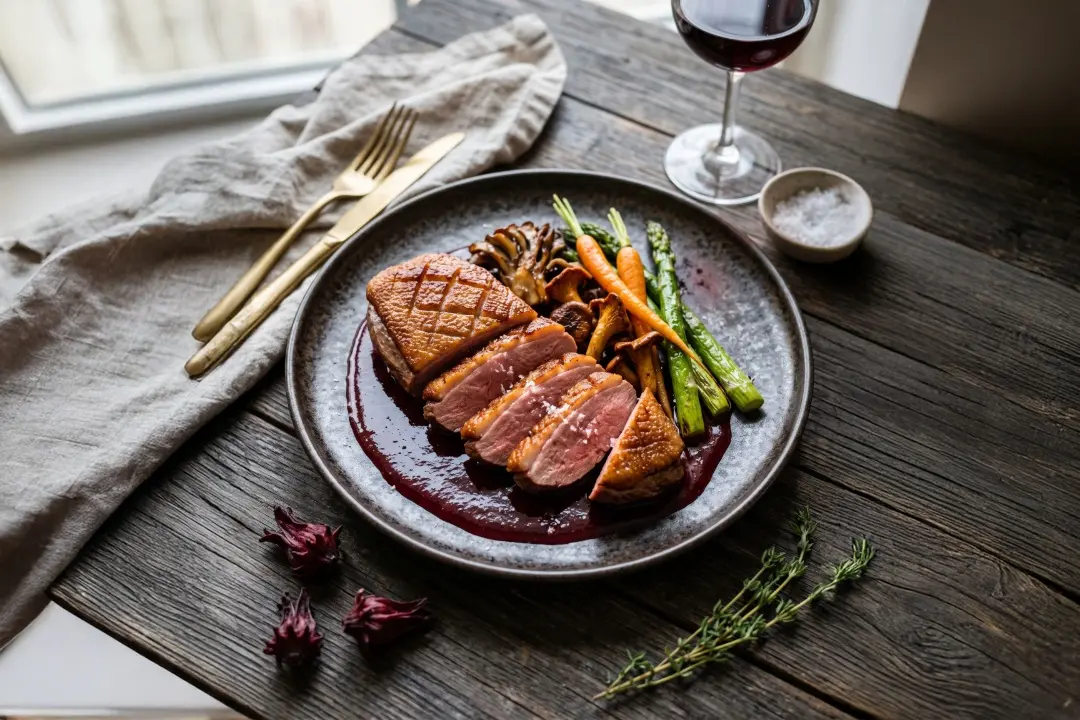
This dish pairs the rich, gamey profile of pan-seared duck breast with the sharp, crimson brightness of a flor de jamaica (hibiscus calyx) reduction. While duck is traditionally paired with sweet fruit gastriques like orange or cherry, hibiscus offers a far more sophisticated profile: vibrant acidity driven by malic, citric, and hibiscus acids, tempered with subtle floral tannins and a hint of warming spice.
Recipe Overview
- Yield: Serves 2 guests (generous portions) or 4 as an intermediate course
- Prep Time: 20 minutes
- Cook Time: 35 minutes
- Total Estimated Time (ETA): 55 minutes
The Science of Flavor Layering
A restaurant-caliber dish succeeds on biochemical contrast:
[ Rich Duck Lipids ] [ Malic/Citric Acids in Jamaica ]
| |
+------------- Bound By --------------------+
|
[ Emulsified Butter (Montez) ]
|
[ Maillard Pyrazines & Earthy Fungi ]
- Lipid Saturation vs. Organic Acid Balance: Duck meat is high in monounsaturated and saturated fatty acids. On its own, it quickly fatigues the palate. The calyces of Hibiscus sabdariffa are rich in malic, citric, and hydroxycitric acids, as confirmed by ScienceDirect research on Hibiscus sabdariffa organic acids. These acids act as natural astringents that sever lipid retention on taste buds, refreshing receptor sites between bites.
-
Pigment Stability & Tannic Grip: The brilliant magenta-ruby hue comes from delphinidin- and cyanidin-based anthocyanins. As documented by the Journal of Agricultural and Food Chemistry on anthocyanin extraction, these molecules remain bright under moderate thermal reduction but oxidize if scorched. Gentle simmering preserves both the visual clarity and natural polyphenols that mimic the tannin structure of an aged red wine.
-
The Maillard Network: Scoring the subcutaneous duck fat increases surface area, expediting moisture evaporation. This triggers amino acid-sugar rearrangements (the Maillard reaction) starting around 140°C (285°F), yielding savory pyrazines and furans. For broader applications of these high-heat surface reactions, review our bone marrow esquites side pairing.
-
Viscosity via Monter au Beurre: A reduction without fat can register as sharp and abrasive. Whisking cold butter into warm acid-rich liquid off the heat creates a microscopic fat-in-water emulsion. The milk solids and triglycerides soften the edges of the organic acids, coating the tongue while maintaining gloss and unctuous cling.
1.Infuse the Hibiscus Decoction:Extracting pigments and organic acids without bitter tannins.Place 25 g dried hibiscus calyces in a heatproof bowl and pour 240 ml of boiling filtered water over them. Submerge the petals completely and steep for 12 minutes.Strain through a fine-mesh chinois into a bowl, pressing the calyces gently with a ladle to extract the concentrated essence. Discard the spent solids and set the deep ruby infusion aside.
2.Prep and Score the Duck Breast:Precision knife work to accelerate fat rendering.Pat the duck breasts thoroughly dry with paper towels—moisture is the enemy of crisp skin. Using a sharp utility knife honed with classic culinary knife skills, score the skin in a tight 5 mm diamond cross-hatch pattern.Cut through the fat cap until the blade barely touches the meat, without puncturing the muscle fibers. Season both sides with kosher salt and black pepper. Allow the duck to rest at room temperature for 15 minutes before cooking.
3.Cold-Pan Sear the Duck BreastSlow rendering prevents buckling and ensures ultra-crispy skin.Place the scored duck breasts skin-side down into a cold, dry, heavy stainless steel or cast-iron skillet. Turn the heat to medium-low.As the pan gently warms, the subcutaneous fat melts and pools in the skillet. Cook undisturbed for 10–12 minutes, using a metal spoon or turkey baster every 3 minutes to siphon off excess liquid fat into a heat-safe ramekin.Once the skin is deep golden-brown and paper-thin, turn the heat up to medium-high for 60 seconds to set the crisp crust. Flip the breast onto the flesh side and sear for 2–3 minutes until the internal core registers 54°C (130°F) for medium-rare, adhering to Food and Drug Administration internal cooking temperature charts. Verify temperature using our kitchen thermometer calibration guide. Transfer the duck to a warm plate, loosely tented with foil, and rest for 8–10 minutes.
4.Build the Hibiscus-Port Pan Reduction:Deglazing fond to unlock savory depth.Pour off all remaining liquid duck fat from the skillet, leaving 1 teaspoon along with the browned fond. Return the skillet to medium heat, add the minced shallot, and sweat for 90 seconds until translucent. Add the crushed garlic, thyme, and Mexican cinnamon stick, stirring for 30 seconds until fragrant.Pour in the red wine and chicken stock, scraping up fond with a wooden spatula (a standard explained in mastering deglazing and pan sauces). Pour in the reserved hibiscus infusion and raw sugar. Simmer over medium-high heat for 6–8 minutes until the liquid reduces by roughly two-thirds, coating the back of a spoon (nappe consistency). Strain the sauce through a fine sieve into a small saucepan over lowest heat.
5.Mount the Sauce (Monter au Beurre):Emulsifying fat globules for mirror-gloss finish.Remove the saucepan entirely from the heat source. Add the cold cubed butter one piece at a time, swirling the pan continuously in circular motions.Follow the Culinary Institute of America technique for monter au beurre to suspend the fat droplets evenly throughout the acidic suspension without breaking. Stir in any juices that pooled on the resting duck plate. Season with a small pinch of sea salt; keep warm, but do not return to a simmer.
6.Sauté the Accompaniments Individually:Preserving distinct textures and caramelization thresholds.Cook each vegetable independently in a separate nonstick or carbon steel pan over medium-high heat with reserved duck fat:
- Wild Mushrooms: Heat 1 tablespoon of duck fat until shimmering. Add the mushrooms in a single uncrowded layer. Leave undisturbed for 2 minutes to brown, toss once, season with salt and thyme, and cook for 2 more minutes until nutty and crisp-tender. Transfer to a holding dish.
- Baby Carrots: Wipe the pan, add 1 teaspoon of duck fat and 2 tablespoons of water or stock. Cook carrots covered for 3 minutes to steam through, then remove the lid and caramelize the cut surfaces for 2 minutes until glossy and tender-crisp.
- Asparagus: Flash-sear the spears in 1 teaspoon of hot duck fat with salt for 2–3 minutes until bright green with gentle blistering.
7.Carve, Plate, and Present:Final assembly for maximum visual and structural impact.Slice the rested duck breast crosswise against the grain at a 45-degree bias into 1 cm thick medallions.Spoon a generous pool of the deep crimson hibiscus reduction onto the center of warm shallow plates. Fan the sliced duck breast across the sauce to keep the skin crisp and above the liquid line. Arrange the wild mushrooms, carrots, and blistered asparagus alongside. Finish with a scatter of flaky sea salt directly onto the pink face of the meat.
Beverage Harmony & Finishing NotesFor wine, avoid heavy, oak-dominated reds whose aggressive tannins will clash with the natural astringency of the hibiscus flower. Instead, follow classic Wine Spectator game bird pairing principles and reach for a cool-climate Oregon Pinot Noir, a cru Beaujolais (Morgon or Moulin-à-Vent), or a peppery Northern Rhône Syrah. The natural red-fruit acidity and floral undertones in these varietals bridge the gap between rich poultry lipids and the tart punch of the reduction.